Sprint 5
A new way forward
The OAM team responded to the options appraisal and our questions about mapping, canonical data sources and dependencies with other work. A major outcome was that our mapping assumptions were wrong. On reflection, the OAM team felt it was not appropriate to map DCF user stories to OAM application capabilities - instead, they suggested DCF application functions should map to OAM application capabilities.
It wasn’t immediately clear how the DCF user stories would map across, so the team had to have a serious rethink.
The prototype surfaced these isssues, which was great. If we hadn’t tested these assumptions, we could have ended up putting a lot of development time into something that didn’t align correctly to OAM. But like any pivot, the team now had to come up with a sensible way forward, replan and reprioritise - without losing velocity. It also needed to bring in extra skills - solution architecture, business architecture - that it didn’t have.
The planning strikes back
A lot of the planning had to be hurriedly revisited. Broadly, the pivot meant:
- planned user research could continue, but might collect different insights from the updated prototype, potentially in a different way
- architecture expertise would be needed to develop a mapping model and get approval from the OAM team before migrating content
- service design (the service proposition itself) would need a rework - user stories support transformation and improvement activity like creating test scripts for EPR improvement work, so they can’t be lost
- strategically, the team would need to work more closely with the team updating the WGLL framework to understand OAM business capabilities (vs application capabilities)
- business analysis work - gap analysis, deduplicating - could continue (on user stories)
- content design work would need to pause, pivoting instead onto engagmement with internal stakeholders to explain the change of direction
Return of the prototype
The team spoke to SCW’s technical architecture community (business architects, solutions architects and enterprise architects). We asked them to provide input into our proposed re-mapping and answer queries (eg whether application functions were grouped appropriately in DCF or whether new groupings would be needed).
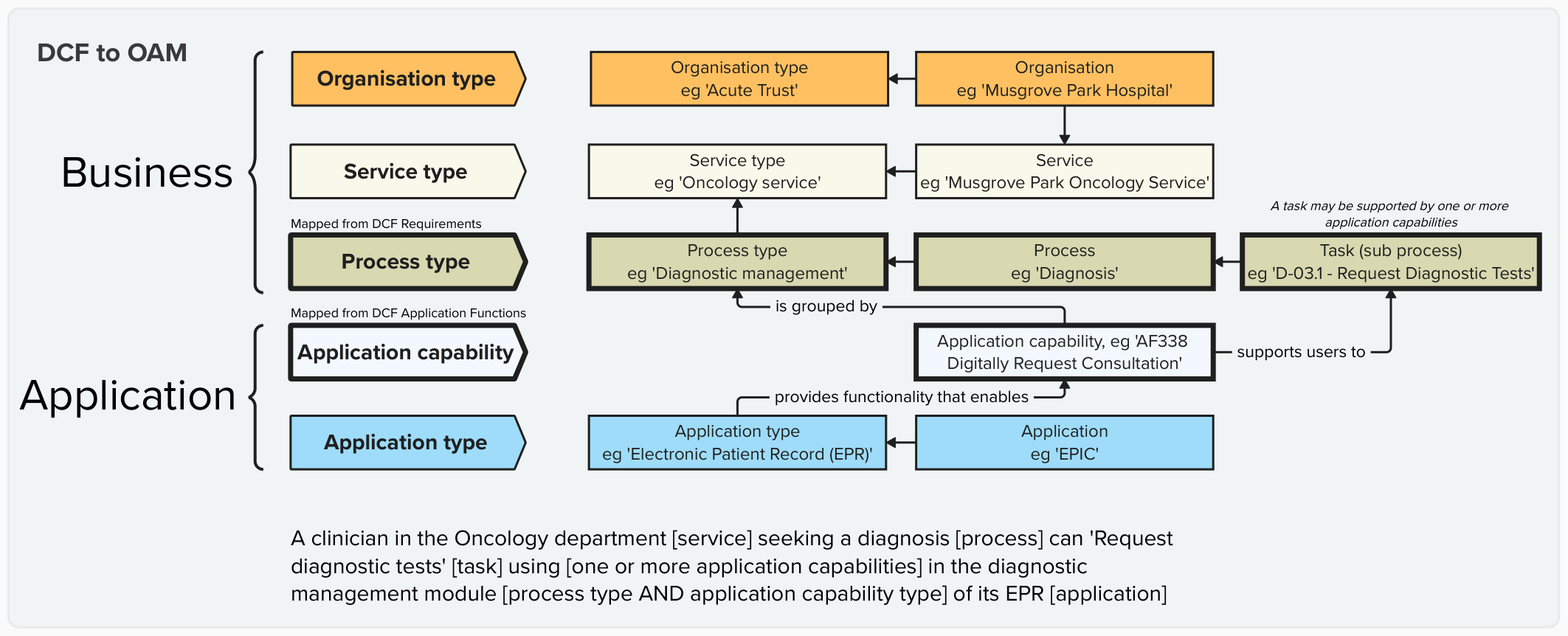
Meanwhile, to keep velocity, the team chose to prototype this proposed OAM mapping in Sprint 6 to ensure it translated readily and intuitively into the end service. User research could help identify areas where the mapping made it less ‘usable’ or ‘useful’ - two key criteria for success.
The team started revising the prototype wireframes to support a full rework of the prototype in Sprint 6, once the proposed re-mapping had been sense-checked.